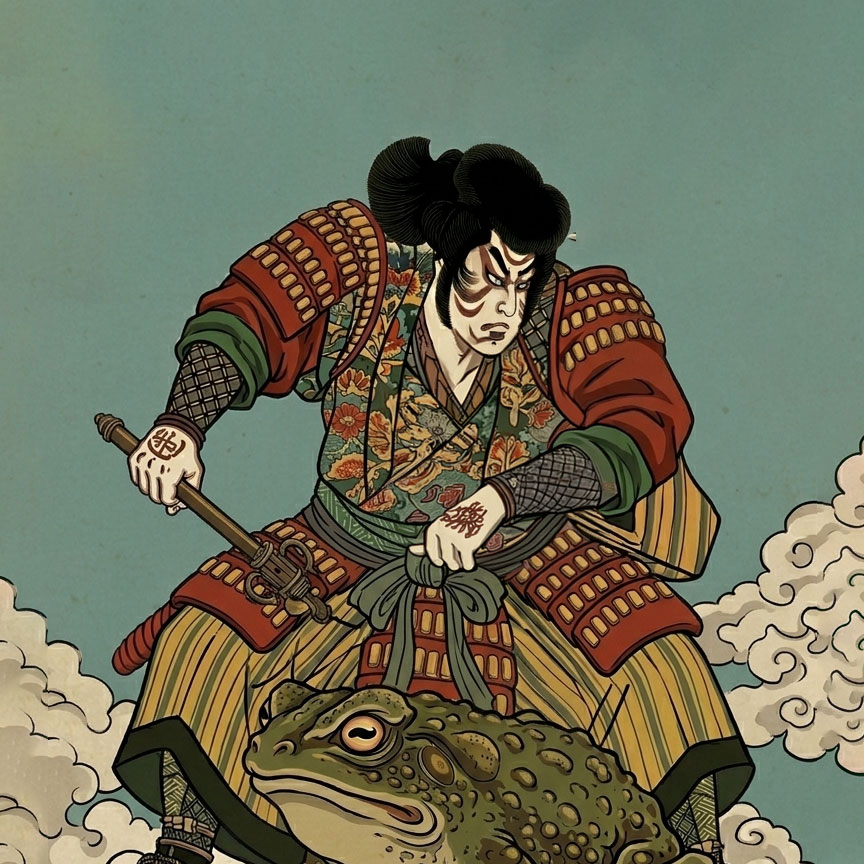
In the late Edo period, a popular illustrated novel called Jiraiya Goketsu Monogatari began publication in the 1830s. It became very popular. The story was written by Mizugaki Egao and illustrated by Utagawa Kuniyoshi.
Jiraiya Goketsu Monogatari in Kabuki
Because of its popularity, it was adapted into a kabuki play in 1852 by Kawatake Mokuami.
The character Jiraiya in kabuki is one of the early models for the “ninja hero” that many people imagine today.
Real ninja were mainly involved in espionage, intelligence gathering, and infiltration. Jiraiya, however, is very different. He is a fantasy hero who uses magical powers, controls a giant toad, and battles powerful enemies.
In the story, Jiraiya uses toad magic. Tsunade uses slug magic, while his archenemy Orochimaru uses snake magic. Jiraiya and Tsunade work together to fight Orochimaru and his forces.
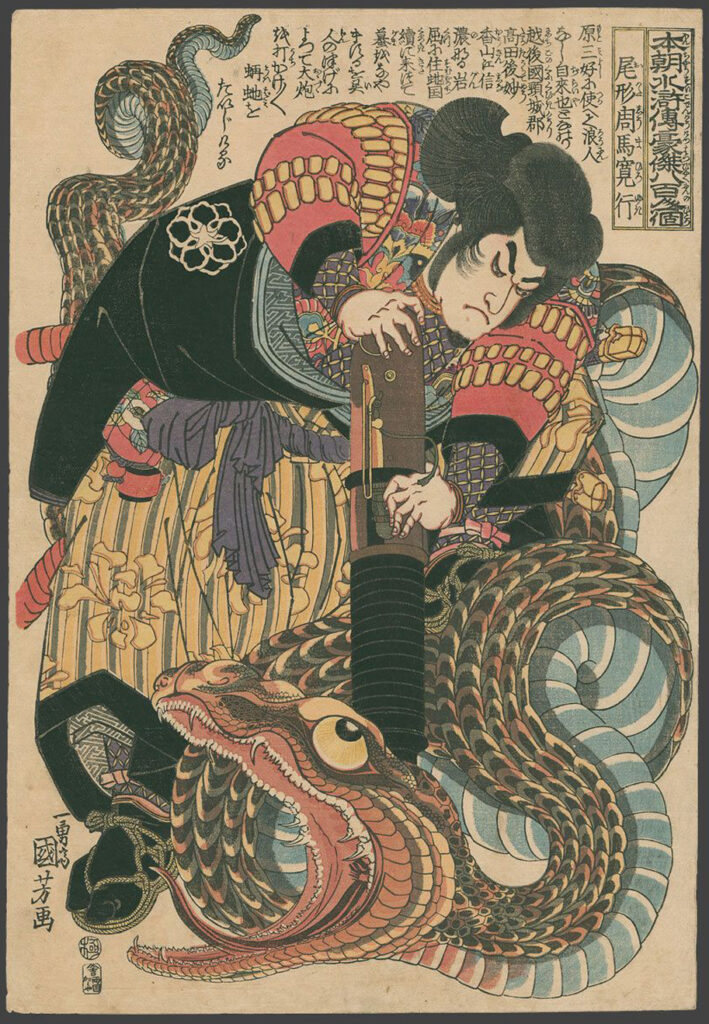
Audiences in the Edo period enjoyed larger-than-life heroes with supernatural abilities more than historically accurate depictions of ninja. For this reason, Jiraiya is closer to a Japanese superhero than to a real historical ninja.
Many of the ninja images known around the world today—such as ninja magic, control over animals, and superhuman combat abilities—developed through the influence of entertainment works like kabuki plays and popular novels.
NARUTO
Fans of NARUTO may also recognize the names Jiraiya, Tsunade, and Orochimaru. These characters were inspired by this much older story.
The story of Jiraiya inspired three homonymous characters in the Naruto franchise. Several names in Naruto, such as the Tsuchikage—used as the title for the leader of the Stone Village—also draw from this folklore. During the Jiraiya Arc and his death scene, the phrase “Tale of the Gallant Jiraiya” is prominently referenced. Many pivotal characters and narrative elements throughout the Naruto manga are heavily influenced by The Tale of the Gallant Jiraiya.
https://en.wikipedia.org/wiki/Jiraiya
By learning about Jiraiya, it becomes easier to understand where many ideas found in modern ninja anime, manga, and popular culture came from.
If you’re interested in the history of ninja, visiting Iga is also highly recommended.