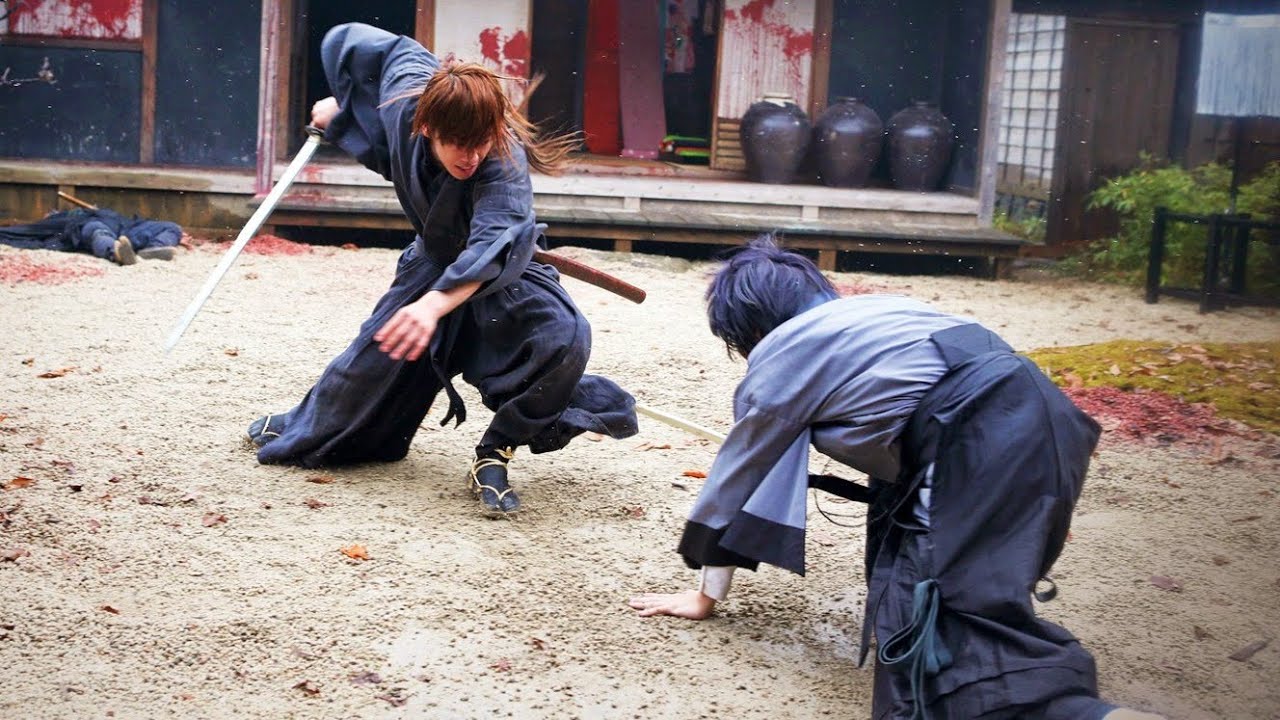
I recently watched the live-action Rurouni Kenshin movie, and I was surprised by how deeply it explores Japanese history. If you’re interested in Japanese culture and samurai, I highly recommend it.
Clashing Justices: The Boshin War
The story is set during a major turning point in Japan, from the end of the samurai era (the Boshin War) to the early Meiji period. The main character, Kenshin Himura, was once feared as a legendary assassin for the new government, known as “Battosai the Manslayer.” In the opening Battle of Toba-Fushimi, the new government raises the Emperor’s flag, showing how “justice” suddenly changes and the old shogunate army becomes labeled as rebels. It clearly shows how fast history can turn.
In the Meiji era, carrying swords was prohibited.
In the Meiji era, swords are banned, and Kenshin chooses to live by a vow of “never killing again.” He carries a reverse-blade sword that cannot easily kill. Even though he is burdened by his past, he tries to protect others without taking any more lives. This reflects a very Japanese sense of honor and responsibility.
Another interesting detail is that Hajime Saito, a former member of the Shinsengumi (the old shogunate’s special police), appears as a police officer for the new Meiji government. This is actually based on real history and shows how samurai had to adapt to a completely new world.
Kenshin’s Action Scenes Are Thrilling
One of the biggest highlights is the action, directed by Kenji Tanigaki, who trained under Hong Kong action legend Donnie Yen. The fight scenes are fast, intense, and filmed from very close angles, sometimes even from the victim’s point of view. By using safe rubber swords, the actors can move at full speed and fight at extremely close range, creating a level of realism rarely seen in traditional samurai films.
The movie is based on a popular manga from the 1990s, later adapted into an anime and then this live-action series. Overseas, it’s also known as Samurai X, and it became a huge box office success in Japan. If you want to see what a “samurai” looks like in the modernizing Meiji era, this film is a great place to start.
Rurouni Kenshin: Live Stage Performance of Kenshin vs Seta Sojiro
Leave a Reply