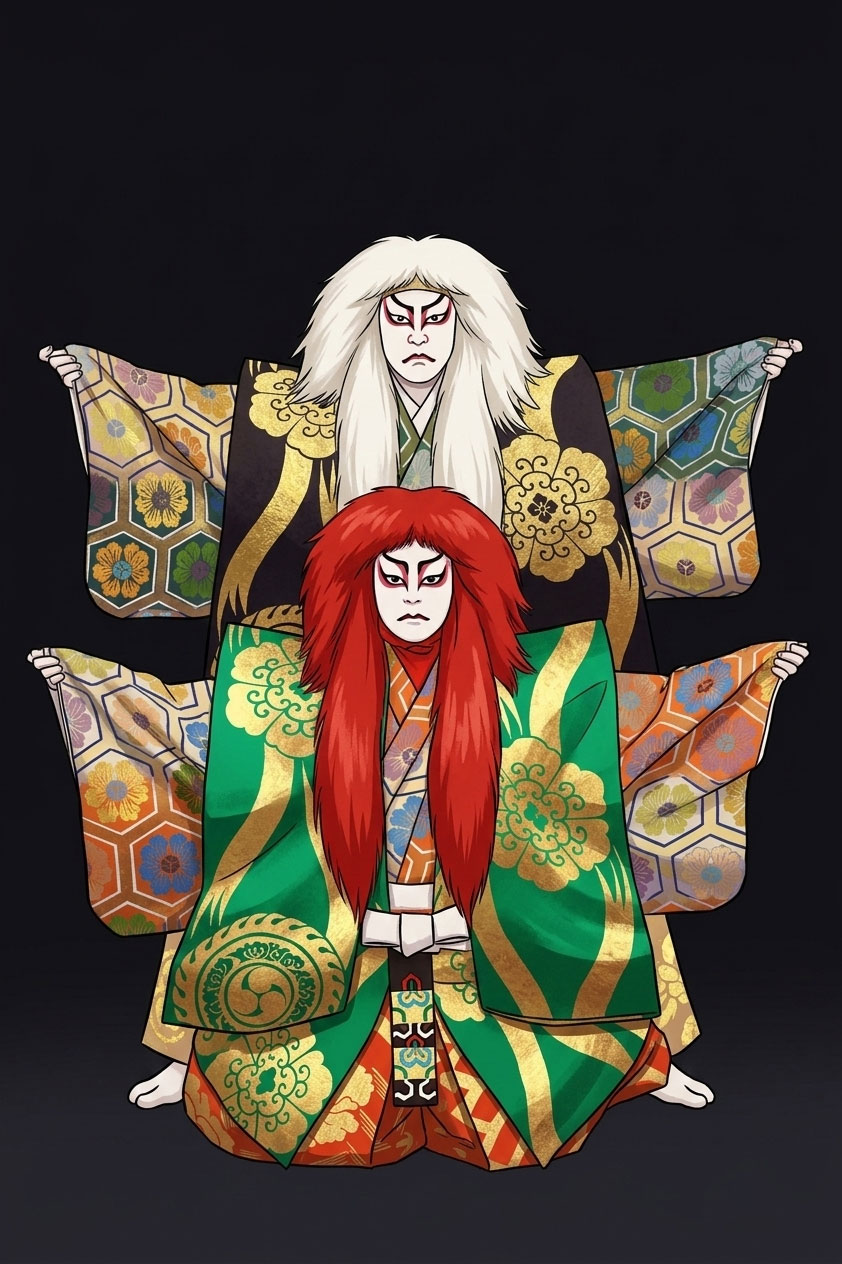
One of the most famous dances in Kabuki is Renjishi (The Parent and Child Lions). Many international audiences simply call it “Two Lions” or “The Father and Son Lions.”
It is especially famous for the powerful scene where performers swing their long hair dramatically in every direction.
The Two Worlds of Kabuki
Kabuki today can roughly be seen in two different worlds.
One is the traditional Kabuki performed in major theaters, where actors from long-established families continue the art under the management of the theater company Shochiku. In this world, traditions are carefully preserved and only a limited number of actors can appear on stage.
The other world is a newer style of Kabuki-inspired performance. Artists use Kabuki techniques but perform outside traditional theaters, sometimes incorporating modern staging, international tours, or online platforms like YouTube.
Even in these modern interpretations, the methods and spirit of Kabuki are used to excite audiences around the world.
But in both traditional and modern forms, one performance remains extremely popular: Renjishi.
The Story of Renjishi
The story takes place on a sacred stone bridge in Seiryōzan, a legendary mountain in China where peonies bloom.
According to an old legend, lions test their cubs by throwing them into a deep valley. Only the cubs strong enough to climb back up are raised by the parent.
In the dance, the parent lion appears strict and pushes the cub into hardship. The young lion struggles again and again but refuses to give up.
Eventually the cub rises with new strength, proving its courage and spirit.
In the final scene, both lions dance together, fiercely swinging their long manes to express overwhelming vitality as sacred beasts.
Origins of the Dance
Renjishi was inspired by the play “Shakkyo” from Noh, an older form of Japanese stage art.
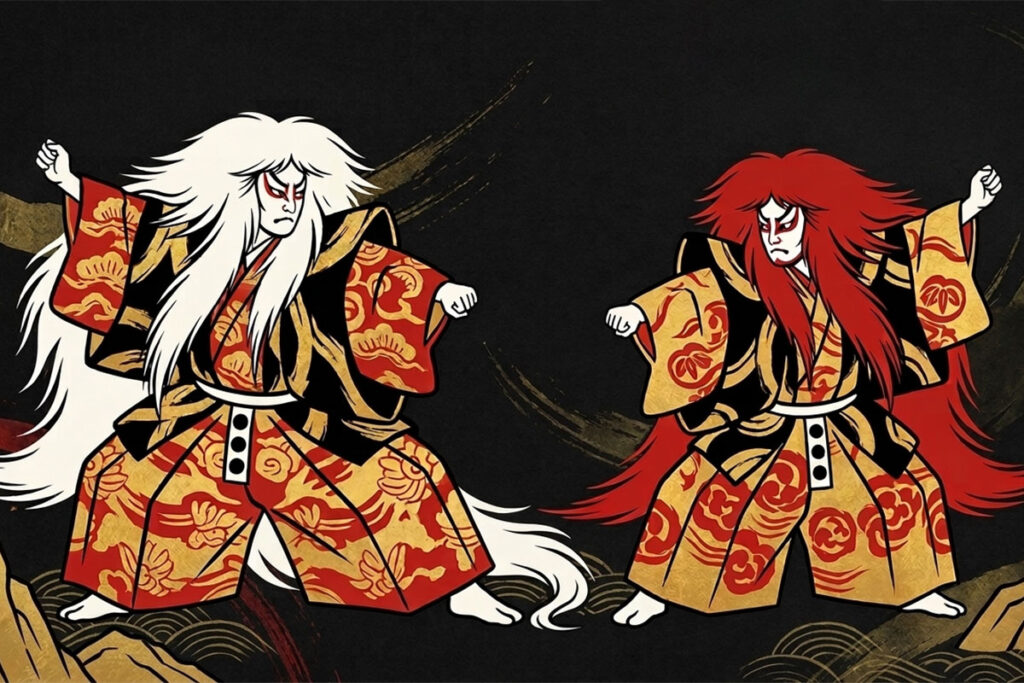
Kabuki masters later transformed it into a spectacular dance piece. Famous actors such as Ichikawa Sadanji I and Onoe Kikugoro V helped refine and popularize the performance.
In Japan, there is also a proverb that says children should experience hardship in order to grow strong.
An Auspicious Performance
In Asian tradition, lions are believed to drive away evil spirits and protect people from misfortune.
Peonies, which bloom in the story’s setting, are called the “king of flowers” and symbolize prosperity and wealth.
Because of this, Renjishi represents protection, prosperity, and long life. It is considered a very auspicious performance.
The story also carries a deeper message: people grow stronger by overcoming trials.
The Costumes
The costumes of Renjishi are famously luxurious and extremely expensive.
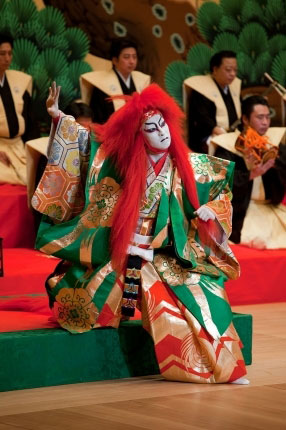
The most striking feature is the long lion mane wigs.
The parent lion wears white hair, symbolizing dignity and authority. The cub wears red hair, representing youthful energy and wild spirit.
Their robes are also magnificent, using rich colors like gold and deep red. Heavy embroidered designs of vines and peonies decorate the costumes, emphasizing that the lions are not ordinary animals but sacred creatures.
Actors also wear dramatic red Kumadori makeup, which expresses power and supernatural strength.
The Famous Hair-Swinging Finale
The most spectacular moment of Renjishi is the final dance called “Keburi,” where the performers swing their long manes with incredible force.
They throw their hair forward, backward, and side to side in powerful rhythm.
The white mane of the parent lion expresses dignity and protection. The red mane of the cub represents youth and fighting spirit.
When both lions swing their hair together in perfect timing, the stage explodes with energy.
This moment symbolizes the cub overcoming hardship and the powerful life force shared between parent and child.
A Story of Family
At its heart, Renjishi is a story about parents and children.
The parent lion throws the cub into the valley not out of cruelty, but to give the child the strength needed to survive in a harsh world.
On stage, the white-maned parent shows strict resolve, while the red-maned cub desperately struggles to keep up.
Eventually the cub becomes strong enough to stand beside the parent.
Through this powerful dance, Renjishi shows the inheritance of spirit from parent to child — a story of growth, courage, and deep family bonds.
Renjishi (連獅子), or Two Lions, is a kabuki dance with lyrics written by Kawatake Mokuami, choreography by Hanayagi Jusuke I and music by Kineya Shōjirō III and Kineya Katsusaburō II, first performed in 1872.
https://en.wikipedia.org/wiki/Renjishi
Leave a Reply