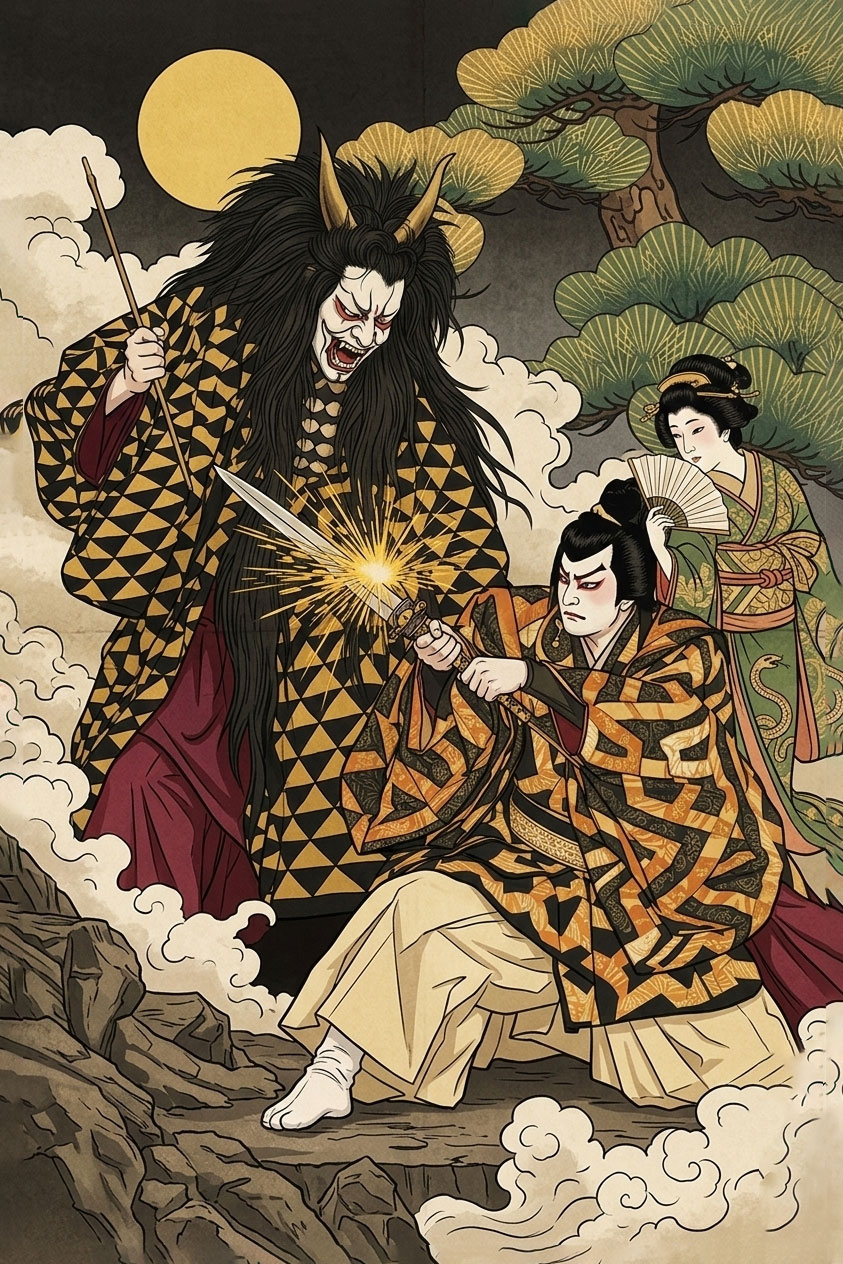
There is a kabuki play called Nihon Furisode Hajime. It is based on the Izumo myth about the defeat of the eight-headed serpent.
The Eight-Headed Serpent and Susanoo
The story of the eight-headed serpent is very famous in Japanese mythology. There is also a traditional Shinto dance called “Oroch iIwami Kagura” in kagura performances.
In the story, sake (rice wine) is prepared, the serpent becomes drunk, and the god Susanoo defeats it.
It is the most popular play of Iwami Kagura. The dancers’ ingenious manipulation of 18 meter long serpent puppets is a great spectacle. It is a story which tells the origin of the Kusanagi Sword, one of the three sacred imperial treasures.
https://masudashi.com/en/kagura-orochi.html
Originally, this work was not a kabuki play but a puppet theater (bunraku) play. It was written in 1718 by the famous playwright Chikamatsu Monzaemon. He is best known for love-suicide dramas, but he also wrote mythological historical plays like this one.
Story of Nihon Furisode Hajime
In the mountains of Izumo, there lived a giant eight-headed serpent called Yamata-no-Orochi. Every year, the villagers offered a young woman as a sacrifice.
This year, the sacrifice is Inada-hime. A woman named Iwanagahime appears. She is actually the serpent in disguise. Although she looks like a beautiful princess, she is the serpent itself. She drinks the sake, becomes drunk, and swallows Inada-hime.
Then her lover, Susanoo, arrives. The sake was poisoned to defeat the serpent. After drinking it, the serpent reveals its true form, and Susanoo fights and defeats it.
On stage, the eight-headed serpent is performed by eight actors. The makeup of the serpent is very powerful and impressive.
Differences from the original Japanese myth
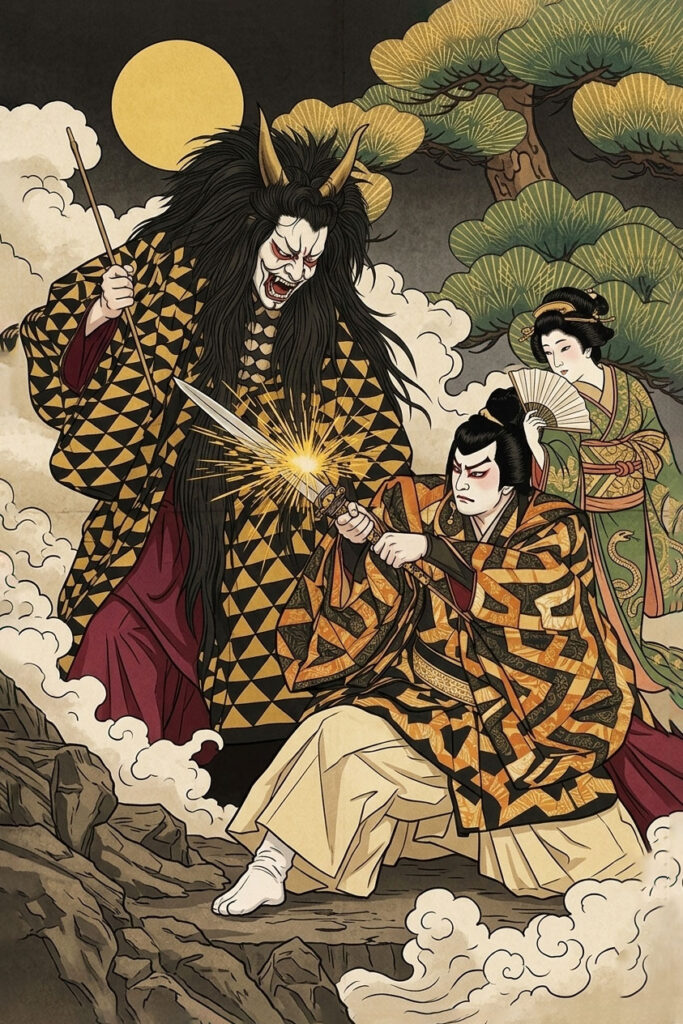
In the original myth, Inada-hime is protected and turned into a comb. In the kabuki version, she is swallowed by the serpent. The story is changed to make it more dramatic for the stage.
In the myth, the serpent appears as a monster from the beginning. In this play, however, a beautiful woman (Iwanagahime) is actually the serpent. Kabuki often enjoys the idea of “a beautiful woman who is secretly a monster.”
In the myth, the sacred sword (Kusanagi no Tsurugi) is found inside the serpent’s tail after it is killed. In the kabuki version, the serpent has already swallowed the sword, and Susanoo fights to take it back. This change makes the story easier to understand on stage.
Why is it called Nihon Furisode Hajime?
The title is interesting. Why is it not called something like “Yamata-no-Orochi”?
In kabuki and bunraku, titles often focus on symbolic events rather than the main action. In this story, after defeating the serpent, Susanoo gives furisode (long-sleeved kimono) to Inada-hime. This scene is considered the legendary beginning of furisode for women in Japan. Therefore, the play is titled Nihon Furisode Hajime, meaning “The Beginning of the Japanese Furisode.”
Kabuki is difficult
Kabuki can be difficult without background knowledge. Even Japanese people sometimes find it hard. When I first watched this play, I fell asleep. But once you understand the meaning, it becomes very interesting as part of Japanese culture.
Kabuki has two main types: jidaimono (historical plays) and sewamono (everyday life dramas). Sewamono are usually easier to understand and more popular. However, I personally prefer jidaimono because I like history.
Leave a Reply